
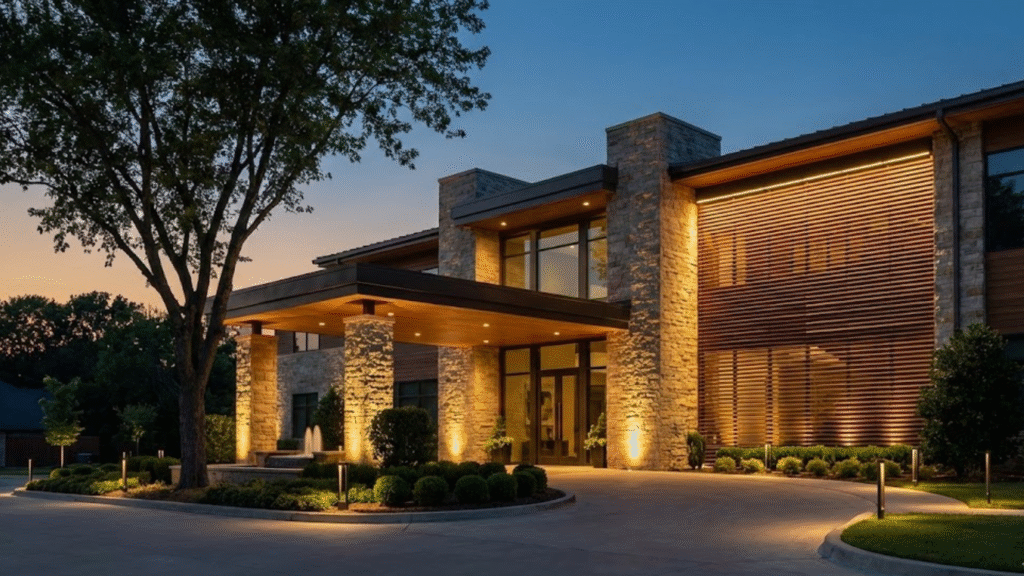
Architectural landscape lighting uses thoughtfully placed outdoor fixtures and smart controls to reveal a building’s shape, materials, and arrival sequence while improving safety and curb appeal. When designers combine uplighting, moonlighting, grazing, silhouetting and wall washing, they guide movement and make facades readable and memorable after dark. This guide walks through why facade lighting matters for homes and businesses, which accent techniques deliver the strongest results, and how modern LED systems and smart controls improve both efficiency and aesthetic control. You’ll also find a practical workflow for design, installation, and maintenance plus real-world examples and easy comparison tables to simplify specifying fixtures and planning installs.
Why Is Architectural Facade Lighting Essential for Residential and Commercial Properties?
Good facade lighting turns flat surfaces into clear, three-dimensional forms at night, improving how a property looks and how people use it. Thoughtful lighting highlights quality materials and architectural details, raises curb presence, and makes entries, steps, and paths safer to navigate. For commercial sites, facade lighting strengthens brand visibility and aids wayfinding; for homes, it boosts curb appeal without intruding on neighbors. Industry research shows well-designed exterior lighting can shape buyer impressions and extend evening usability, so it’s an investment in both appearance and function. Below we break these benefits into tangible outcomes for curb appeal, value, and safety.
This section outlines the core, immediate benefits of facade lighting:
- Enhanced Curb Appeal: Strategic illumination brings out materials and massing for a refined nighttime presentation.
- Increased Property Value: Nighttime usability and visible quality can positively influence buyer perception and marketability.
- Improved Safety and Wayfinding: Layered lighting reduces trip hazards and clarifies circulation for residents and visitors.
Those outcomes flow directly from the design choices discussed next—technique selection, fixture type, and placement.
What Benefits Does Facade Lighting Provide for Curb Appeal and Property Value?
Facade lighting emphasizes textures, edges, and architectural lines so a property reads as intentional and well cared for after dark. Selective illumination—grazing a textured stone wall, uplighting a portico, or backlighting an entry—creates depth through contrast and makes photographs and listings more compelling. These visual cues matter to appraisals and buyer impressions because they extend the perceived and functional living space into the evening hours. Knowing which elements to light first helps prioritize work for the best return on investment.
Next, we’ll cover how layered facade lighting also improves safety and security.
How Does Facade Lighting Enhance Safety and Security?
Good facade lighting increases visibility at entries, steps, and walkways, lowering fall risk and making routes easy to read at night. The goal is to remove dangerous shadows while preserving contrast so people aren’t blinded by glare. For example, low-angle step lights combined with softly uplit facades create a clear, comfortable visual field. On the security side, consistent perimeter illumination improves natural surveillance and deters opportunistic intruders—when it’s balanced with dark-sky practices. Photometric planning, shielding, and zoned controls let you meet security goals without creating stray light or neighbor complaints. With safety benefits defined, the next section explores the accent techniques that create those effects.
After outlining why facade lighting matters, Natural Concepts — a family- and veteran-owned studio in Houston with licensed staff and award-winning design — provides full-service landscape lighting: custom plans, licensed installation, and ongoing maintenance. We focus on elevated lighting solutions, clear project management, and satisfaction guarantees, and we offer complimentary consultations to assess your facade goals and recommend next steps.
What Are the Key Exterior Accent Lighting Techniques to Highlight Architectural Features?

Accent techniques are the designer’s toolkit for shaping a facade’s nighttime character. Uplighting brings texture and drama from the ground up; moonlighting mimics soft overhead light from high mounts; grazing sculpts relief by keeping fixtures close to textured surfaces; silhouetting defines profiles by backlighting; and wall washing delivers even, gentle coverage across flat planes. Your choice depends on material, scale, and whether you want to emphasize texture, outline, or broad visibility. The table below shows when to use each technique and the fixtures that typically produce the effect.
Introduce the comparative reference for accent techniques:
| Technique | Typical Fixtures | Best Use Cases | Visual Effect |
|---|---|---|---|
| Uplighting | Low-voltage spotlights | Columns, trees, vertical textures | Strong shadows, emphasized texture |
| Moonlighting | High-mounted LED spots | Canopied trees, large yards | Soft, natural overhead shadows |
| Grazing | Linear grazers, narrow-beam spots | Stone, brick, textured walls | Enhanced relief, high texture contrast |
How Does Uplighting Dramatically Showcase Facades and Textures?
Uplighting places low-angle fixtures near a wall or architectural element to throw light upward, revealing texture and creating pronounced shadowing that brings surfaces alive. Adjustable heads and narrow-to-medium beam angles let designers control spread and intensity, avoiding unwanted wash. Spacing and distance are key: fixtures 1–2 feet from a textured wall give crisp relief, while moving them back softens the effect. Uplighting excels on stone, masonry, and sculptural features where material depth is a defining character. Mastering uplighting helps when combining it with grazing or silhouetting to keep a balanced nighttime composition.
Next: moonlighting, an overhead approach that creates natural-looking shadows and ambiance.
What Is Moonlighting and How Does It Create Natural Shadow Effects?
Moonlighting mounts fixtures in trees or high on structures to cast gentle, dappled light downward—think soft moonbeams rather than spotlights. Fixtures for moonlighting usually have wider beams and are positioned high to create overlapping pools that reveal patios, walkways, and facade planes with subtlety. Key considerations are canopy density, mounting height, and careful aiming to avoid glare into living areas. Properly executed moonlighting pairs beautifully with uplighting, balancing drama with atmosphere for residential settings that want a relaxed, natural nightscape.
How Do LED Landscape Lighting Solutions Improve Energy Efficiency and Aesthetics?
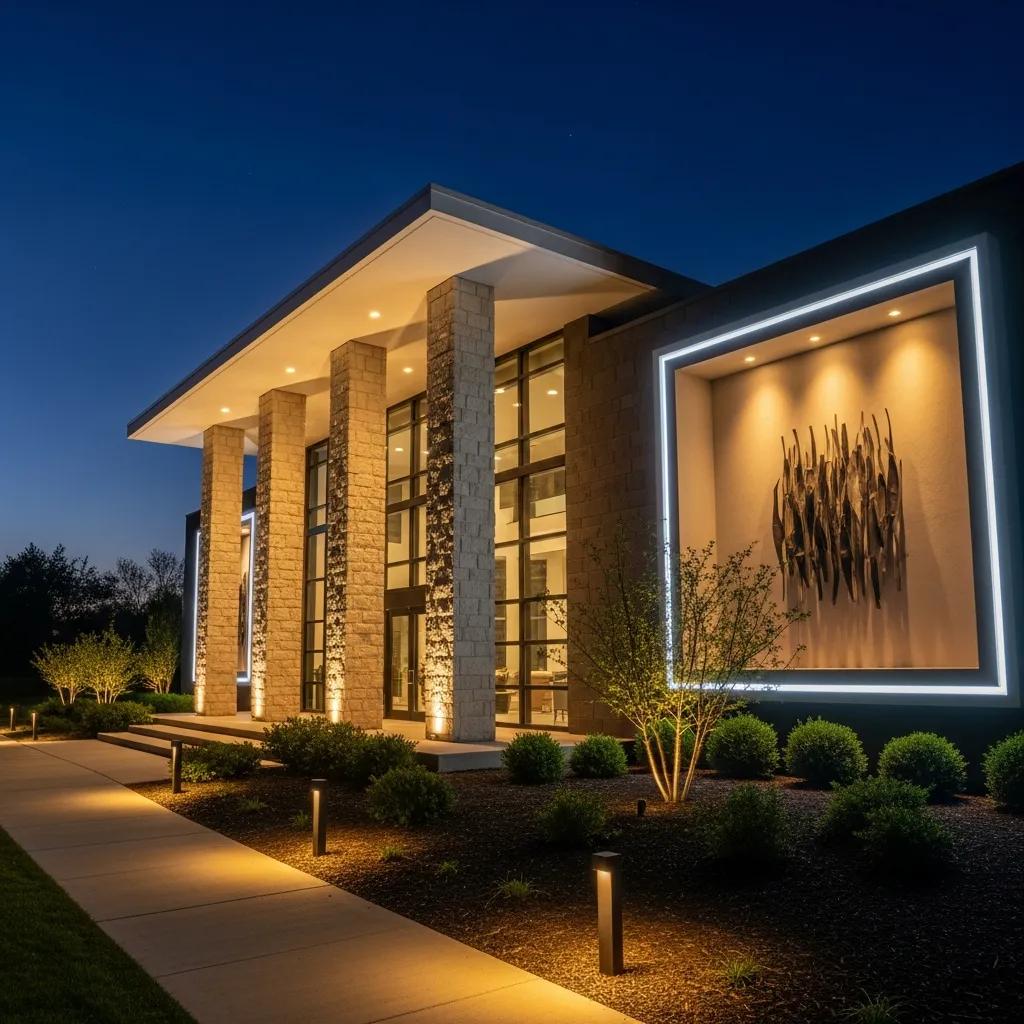
LED lighting changed both the economics and the creative possibilities for facades. LEDs offer high efficacy, long life, and tight optical control, which means lower energy use and smaller fixtures that still achieve the desired visual result. Color temperature and CRI choices affect how materials read—warmer tones (2700–3000K) flatter stone and brick, while higher-CRI options render colors more accurately for branded environments. LEDs pair well with low-voltage transformers and smart controls for scheduling, dimming, and scene-setting, further cutting energy and improving convenience. The section below breaks down common LED fixture types, power profiles, and maintenance expectations to guide specification.
LED technology has reshaped how designers and communities think about facade presence in cities and neighborhoods.
LED Facades in Urban Architecture & Aesthetic Design Rapid advances in electronic lighting have opened new ways to shape urban facades and public space at night. LEDs and panel systems let architects and lighting designers treat building exteriors as active visual elements around the clock, changing how people experience place and the visual identity of neighborhoods. LED facades in urbarchitecture, A Kostić, 2012
Before the fixture table, here’s a quick list of the primary LED advantages:
- Energy Efficiency: Lower wattage for the same lumen output versus older technologies.
- Longevity: Longer rated lifespans that reduce replacements and labor.
- Color and Control: Tunable color temperatures and easy integration with smart controls.
The table below compares common LED fixture types to help with specification.
| Fixture Type | Power Draw (W) | Typical Lifespan | Typical Color Temperatures | Maintenance Notes |
|---|---|---|---|---|
| LED Spotlight | 4–12 W | 35,000–50,000 hours | 2700–4000K | Occasional cleaning, aim check |
| Linear Grazer | 6–20 W | 35,000–50,000 hours | 2700–3500K | Inspect seals, clean lenses |
| Wall Washer | 10–30 W | 35,000–50,000 hours | 3000–4000K | Verify even output, lens replacement if needed |
This comparison shows how LEDs lower operating cost and maintenance while expanding design options. Many firms now default to LED-first strategies for modern facade work.
At Natural Concepts we favor LED systems paired with smart control platforms for energy savings and simplified maintenance. Our licensed team selects color temperatures and optics that match the building’s materials, configures low-voltage transformers, and programs schedules that balance nighttime presentation with energy budgets and local lighting rules.
What Are the Advantages of LED Lighting for Architectural Facades?
LEDs deliver measurable savings in energy and lifecycle costs, allowing designers to hit target illuminance with smaller fixtures and lower wattage. With rated lives typically between 35,000 and 50,000 hours, LEDs reduce replacement frequency and labor—an important consideration for commercial facades that require consistent nightly presentation. LEDs also offer precise beam shaping and dimming that support layered schemes without excessive spill. Wide CRI and color-temperature options let teams tune mood and material appearance so stone, brick, and metal look their best at night.
Next we’ll cover how smart controls amplify those benefits through automation and user-friendly management.
How Can Smart Outdoor Lighting Controls Enhance Custom Ambiance and Convenience?
Smart controls—from simple timers to scene-based mobile apps—let you schedule, dim, and zone facade lighting so it serves both aesthetic and operational needs. Controls can run a low-security scene overnight, step up accents for events, or temporarily disable zones to meet ordinances. Remote access and scene presets make it easy for homeowners and property managers to create consistent night experiences and troubleshoot issues quickly. When integrated correctly with LED drivers and low-voltage systems, smart controls reduce installation complexity and deliver flexibility for years of changing needs.
How Do Residential and Commercial Facade Lighting Designs Differ?
Residential and commercial facade lighting share the same fundamentals, but scale, codes, and priorities differ. Homes focus on curb appeal and neighbor-sensitive ambiance; commercial projects emphasize branding, wayfinding, and maintainability. Residential work usually uses smaller fixtures, warmer color temperatures, and concealment tactics like hidden uplighting and moonlighting. Commercial jobs often call for zoned controls, vandal-resistant fixtures, higher lumen output for signage and entries, and coordination with facility teams. Below is a quick comparison of priorities and typical fixture/control choices.
| Client Type | Primary Goals | Design Priorities | Example Fixtures/Controls |
|---|---|---|---|
| Residential | Curb appeal, ambiance | Concealment, warm color temps | Low-vol spotlights, moonlighting; simple smart controls |
| Commercial | Visibility, safety, branding | Durability, zoned control, code compliance | Vandal-resistant fixtures, wall washers; advanced scheduling |
With those differences in mind, the next sections share Houston-focused residential best practices and commercial strategies for property managers.
What Are Best Practices for Residential Facade Lighting in Houston?
Houston’s humid subtropical climate requires attention to waterproofing, corrosion resistance, and plant-aware fixture placement. Choose marine-grade finishes and sealed fixtures to prevent early failure, and favor 2700–3000K color temps to keep brick and wood looking warm and natural. Plan moonlighting around native canopies and avoid over-illumination that could upset neighbors or violate ordinances. Pair low-voltage systems with simple smart schedules so residents can cut energy use and automate evening scenes. These practical choices deliver durable, neighbor-friendly facade lighting that stands up to local conditions.
Those weather and planting considerations lead into commercial priorities like durability and ease of maintenance for high-use properties.
How Is Commercial Building Lighting Designed for Business and Property Management Needs?
Commercial lighting must support brand presentation, meet safety codes, and be cost-effective to maintain. Designers specify fixtures with high IP ratings, tamper-resistant mounts, and easy service access to limit downtime. Zoned dimming and scheduling support energy management and after-hours security. Photometric studies ensure facade visibility and safe pedestrian circulation, and coordination with architects and facility managers handles power and conduit routing. Commercial solutions balance visual impact with lifecycle cost control to deliver measurable ROI through extended nighttime activity and better tenant or customer experience.
Next we outline a clear process from initial consultation through long-term maintenance and retrofits.
What Is the Process for Designing, Installing, and Maintaining Architectural Landscape Lighting?
A consistent process keeps facade lighting true to the design and reliable over time: site consultation, custom design with photometrics, licensed installation, and scheduled maintenance with retrofit planning. In consultation we identify focal points, routes, and constraints. Design uses photometrics to specify fixtures, beam angles, and control zones. Licensed installation ensures correct low-voltage wiring, transformer sizing, and weatherproofing. Routine maintenance and planned retrofits—especially LED upgrades or control additions—preserve performance and appearance. The steps below summarize the workflow and expected outcomes.
- Site Consultation and Goals: Assess focal points, access, and neighbor constraints to define objectives.
- Custom Design and Photometrics: Specify fixtures, beam angles, and control zones for the intended visual result.
- Licensed Installation: Execute wiring, mounting, and commissioning with weatherproof practices.
- Maintenance and Retrofit Planning: Schedule inspections, cleaning, and plan LED or control upgrades as needed.
These steps form a clear roadmap from concept to reliable long-term operation. Natural Concepts follows this approach: a complimentary consultation, a custom lighting plan with professional photometrics, licensed installation by our trained staff, and ongoing maintenance and retrofit services to keep your facade looking its best. Request a consultation to review your goals and get tailored recommendations.
How Does the Landscape Lighting Design Process Ensure Optimal Facade Highlighting?
Design begins with a site survey that documents focal points, materials, sightlines, and the surrounding landscape to set target light levels and fixture locations. Photometric studies simulate night views and guide beam-angle and spacing decisions to avoid glare and spill. On-site mock-ups and temporary fixtures let us test aiming and intensity before final installation so the outcome matches expectations. Choosing optics and IP-rated fixtures for durability and documenting zones and control schemes simplifies future service. This iterative, measurable process delivers facade lighting that matches the original design intent.
The next section covers maintenance routines and retrofit strategies that preserve performance over time.
What Are Key Maintenance and Retrofitting Considerations for Long-Term Performance?
Regular maintenance keeps systems performing and prevents premature failure. Typical tasks include lens cleaning, aiming checks, transformer inspections, and verifying seals and wiring on an annual or biannual schedule. Monitoring lumen depreciation and color shift helps decide when to retrofit—upgrading to LEDs or LED retrofits often pays back in lower energy and maintenance costs. Retrofitting requires checking transformer capacity and driver compatibility and may include adding smart controls for dimming and scheduling. A simple checklist and planned retrofit timeline help owners budget and avoid sudden outages, keeping the facade compelling year after year.
With maintenance practices in place, real-world examples show how techniques and processes come together on actual projects.
Where Can You See Examples of Effective Architectural Facade Lighting?
Case studies and photo galleries show how techniques translate into finished work and help clients imagine outcomes for their property. Good galleries pair before-and-after images with short captions that explain the challenge, the chosen technique, and the result—like using grazing to restore depth to a weathered stone wall or combining uplighting and moonlighting for layered residential ambiance. Commercial cases often highlight measurable benefits such as improved nighttime visibility, tenant satisfaction, or reduced maintenance. Reviewing a portfolio helps pick the right mix of techniques for scale and budget. Below are concise project types to look for in galleries and case studies.
Below are descriptions of project types to look for in galleries and case studies:
- Residential Transformations: Small-lot homes that feel larger at night through strategic uplighting and concealed fixtures.
- Commercial Upgrades: Office campuses and retail facades improved for safety and brand presence using wall washers and zoned controls.
- Landscape-Integrated Solutions: Projects where moonlighting and plant-aware placement create cohesive outdoor living environments.
These examples show typical goals and how different techniques solve real-world challenges. The next subsections offer short case descriptions for residential and commercial work.
What Residential Projects Showcase Uplighting and Moonlighting Techniques?
One residential project paired uplighting on a textured stone entry with moonlighting in the canopy to create an inviting arrival: uplighting defined the entrance while high-mounted tree fixtures cast soft pools across the driveway. Another used grazing on a low garden wall to restore depth to a flat elevation, improving listing photos and evening gatherings. A third home combined warm 2700K LEDs with smart scheduling to keep a neighbor-friendly ambiance while extending evening outdoor use. Each example shows how technique, fixture choice, and control strategy meet homeowner priorities like curb appeal, efficiency, and low upkeep.
These residential cases lead into commercial-scale examples where durability and maintenance planning are central.
Which Commercial Projects Demonstrate Security and Accent Lighting Solutions?
Commercial examples include office buildings that paired wall washers for uniform facade illumination with uplighting to emphasize entries and signage, improving wayfinding and brand presence after dark. An HOA common-area project used vandal-resistant fixtures and zoned controls to balance safety lighting for paths with softer accent lighting for communal spaces. Retail upgrades often rely on high-CRI LEDs and precise beam shaping so merchandise and architectural features appear true at night. These projects highlight coordination with property teams for maintenance scheduling and automated controls for energy optimization, showing how technical choices create measurable operational benefits.
Frequently Asked Questions
What are the most common mistakes to avoid when designing facade lighting?
Over-illumination is one of the biggest mistakes—too much light creates glare and flattens architectural depth. Other common issues are ignoring the surrounding environment (which can cause light pollution or neighbor complaints) and specifying fixtures that clash with the building’s style. Proper planning, photometric analysis, and on-site mock-ups prevent these problems and ensure the lighting enhances the property.
How can I choose the right color temperature for my facade lighting?
Color temperature depends on material and the mood you want. Warmer tones (2700K–3000K) flatter natural materials like wood and stone. Slightly cooler ranges (3000K–4000K) suit modern or commercial facades that need a crisper look. Test options onsite when possible—color interacts with surface texture and landscape, and a mock-up helps confirm the right choice.
What maintenance is required for outdoor lighting systems?
Plan routine maintenance at least annually: clean lenses, check aiming, inspect transformers and seals, and test wiring. Monitoring lumen output and color helps decide when to replace or retrofit fixtures. Regular maintenance prevents failures and keeps the facade looking intentional.
How do I integrate smart controls with my facade lighting?
Choose LED fixtures and control systems that are compatible—this enables timers, dimming scenes, and remote management. Smart controls let you automate night scenes, boost lighting for events, or comply with local rules. Confirm wiring and transformer compatibility during design to ensure a smooth integration.
What factors should I consider when selecting fixtures for facade lighting?
Consider the building’s style, the lighting effect you want, and local environmental conditions. Prioritize durable, weather-resistant fixtures with appropriate beam angles and optics for the chosen technique (uplighting, grazing, etc.). Also weigh energy efficiency and maintenance needs to keep long-term costs predictable.
Can facade lighting improve the security of a property?
Yes. Properly layered facade lighting illuminates entries, walkways, and perimeters to reduce opportunities for intruders and increase visibility for residents and visitors. The key is balancing security levels with aesthetics so you avoid harsh glare and preserve a welcoming nightscape.
Conclusion
Architectural facade lighting enhances a property’s appearance while improving safety and usability after dark. Techniques like uplighting and moonlighting let homeowners and businesses create welcoming, distinctive nightscapes that boost curb appeal and brand presence. Modern LED systems and smart controls deliver energy savings and long-term reliability, making facade lighting a strategic investment. If you’d like help translating these ideas to your property, schedule a complimentary consultation with our team and we’ll walk you through options tailored to your goals.