
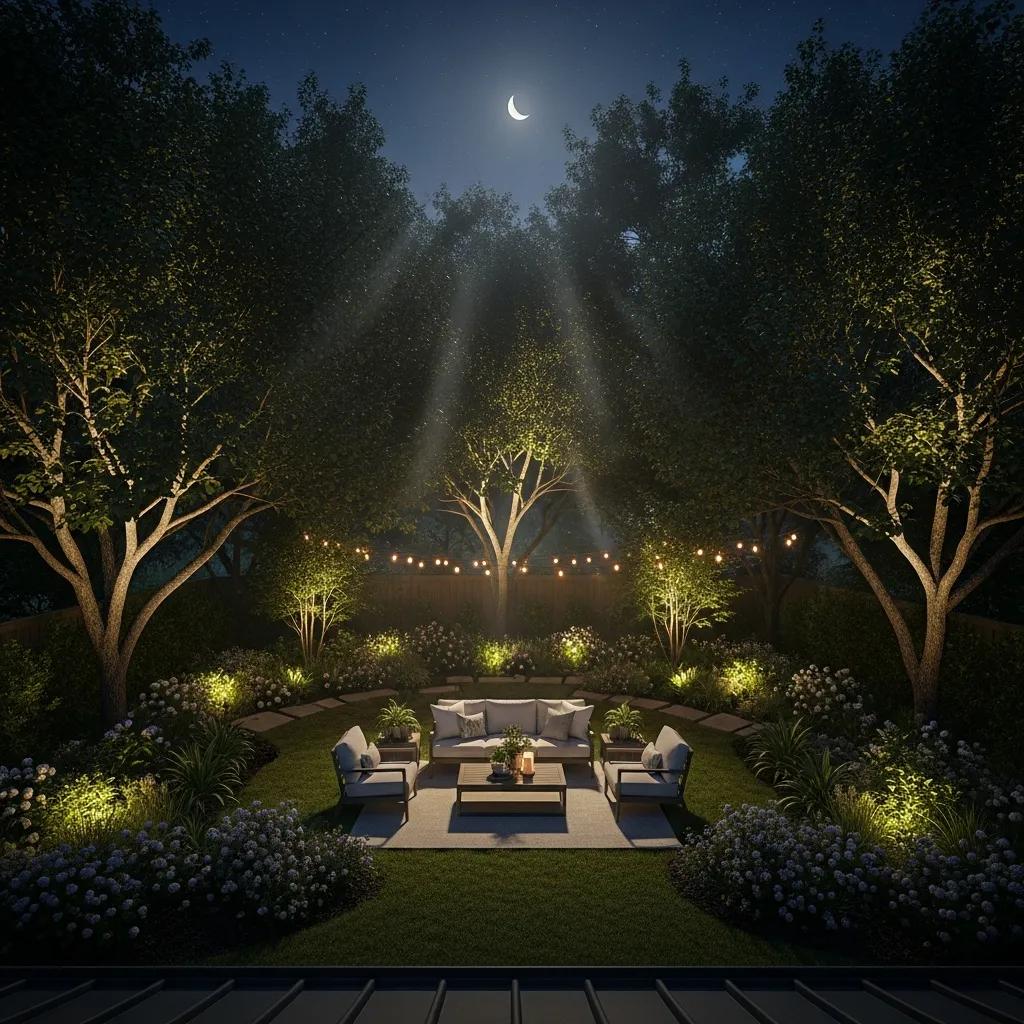
Moonlighting is a landscape lighting approach that recreates the soft, dappled glow of real moonlight by mounting fixtures high in trees or on elevated structures so light filters down through leaves and branches. The result is layered, understated illumination that improves evening atmosphere while handling practical needs like safe circulation and perimeter awareness. Below we explain what moonlighting is, how placement and beam control produce a convincing moonlight effect, the benefits for homes and businesses, and how moonlighting compares to uplighting and path lighting. We also cover LED advances that make moonlighting more efficient and smarter, outline a Houston-ready installation process, and show how Natural Concepts applies local experience to custom projects and consultations.
What Is Moonlighting in Landscape Lighting?
Moonlighting is a downlighting technique where fixtures sit high in a canopy or on an elevated structure to cast a gentle, downward wash that reads like moon glow. The effect depends on beam angle, fixture optics, color temperature, and canopy density: foliage breaks the beam into dappled highlights and soft shadows, reducing harsh contrast and glare while revealing texture and form. The finished look is layered and natural — visible enough for evening use but never stage-lit. Grasping these basics makes it easier to see why designers choose moonlighting when subtlety and naturalism are priorities, and it sets up how LED optics refine the effect.
Experts highlight the fundamentals of outdoor downlighting and strategic fixture placement for achieving natural-looking moonlight effects.
Outdoor Moonlighting & Downlighting Techniques This practical guide covers the essentials of outdoor downlighting—how to place lights in trees or on structures and use low-energy LEDs or solar options to create convincing moonlighting effects.
Natural Concepts brings focused design experience to moonlighting projects across Houston and Southeast Texas. We’re a veteran-owned, family-run team known locally for luxury landscape lighting with an emphasis on natural downlighting and dappled effects. Our local knowledge helps us choose fixtures and placement that suit the mature canopies common in Houston neighborhoods. Licensed electricians on our crew install to code for homeowners and commercial clients, including architects and property managers, ensuring the final result meets both aesthetic and functional goals. Next, we’ll explain how moonlighting visually mimics real moonlight.
How Does Moonlighting Mimic Natural Moonlight?

Moonlighting recreates moonlight by placing downward-directed fixtures high above the ground with moderate beam spreads and warm-to-neutral color temperatures. Carefully chosen optics and beam control let light pass through foliage so leaves and branches break the beam into the dappled highlights and soft shadows you’d expect under a night sky. Designers pick color temperatures to set mood, but the priority is always subtle contrast — not harsh, artificial beams.
Typical mounting heights for this effect range from about 12 to 20 feet in mature trees, with adjustable swivel mounts so installers can fine-tune optics on site for the best dappled spread.
Good design also checks canopy density and sightlines to avoid shining directly into windows or creating glare for neighbors. Planning mount points and aim angles before installation prevents common mistakes like overspill on facades, so the scheme reads as ambient and natural rather than theatrical. With that in place, you can evaluate moonlighting designs by their signature traits.
What Are the Key Characteristics of Moonlighting?
Moonlighting has a few clear, measurable traits that set it apart: top-down focus, soft shadowing, low contrast, and easy layering with other fixtures.
On your checklist, look for fixtures mounted above eye level, beam spreads that avoid glare, color temperatures in the warm-to-neutral range (about 2700–3500K), and careful zoning so seating areas feel welcoming.
Also check the components: tree-mounted fixtures, low-voltage transformers, and beam optics that allow precise tuning. These parts affect long-term performance and maintenance. When balanced well, moonlighting creates a calming, natural nighttime ambiance that invites use and preserves a landscape’s evening character — benefits we’ll explore next.
What Are the Benefits of Moonlighting for Outdoor Spaces?

Moonlighting delivers both aesthetic and practical advantages: it improves ambiance, increases safety and visibility, lowers energy use when paired with LEDs, and enhances curb appeal and perceived property value. The reason is simple — soft, high-placed light brightens paths and gathering spots while keeping landscape elements in pleasing relief, supporting evening activities without creating light pollution or visual discomfort. Because it’s subtle, moonlighting suits residential patios, commercial campuses, and historic settings where dramatic illumination would feel out of place. Knowing these benefits helps property owners favor moonlighting when they want natural-looking, understated lighting.
The table below compares how moonlighting provides these benefits versus uplighting and path lighting so you can weigh strengths and use cases.
| Technique | Primary Benefit | How the Benefit Is Delivered |
|---|---|---|
| Moonlighting | Natural ambiance & soft safety | High canopy placement with downward beams creates dappled, glare-free visibility |
| Uplighting | Dramatic architectural emphasis | Ground-mounted fixtures aim upward to silhouette structures and highlight textures |
| Path lighting | Direct circulation safety | Low-mounted fixtures illuminate walking surfaces and step edges with focused beams |
This comparison shows moonlighting excels when you want a layered, natural nightscape while other techniques deliver drama or focused task lighting. Mixing approaches often yields the best overall plan.
Key practical benefits to consider:
- Enhanced ambiance: Filtered, top-down light creates a calm evening setting for gatherings and relaxation.
- Improved safety: Downlighting brightens steps and paths without creating glare that hides hazards.
- Energy efficiency: Using LED fixtures and zoning reduces operating costs and energy waste.
These outcomes explain why moonlighting is a popular choice where both beauty and after-dark usability matter. Next, we’ll compare moonlighting directly with other techniques to help you decide when it’s the right option.
How Does Moonlighting Enhance Ambiance and Aesthetics?
Moonlighting sculpts space with gentle top-down illumination that brings out texture and depth through soft shadows. Light filtered through foliage creates layered luminance that reveals form without flattening contrast or washing colors. Practically, moonlighting can extend usable hours for patios and lawns, creating inviting fields of view while keeping a sense of intimacy and privacy. Designers often show photos or mockups to demonstrate how subtle downlighting transforms a yard from invisible at night to a tranquil, textured setting.
We commonly pair moonlighting with focused uplighting on specimen plants or architecture to create a balanced nightscape that reads well from near and far. That layered approach preserves dark-sky goals while improving safety — which we cover next.
In What Ways Does Moonlighting Improve Safety and Security?
Moonlighting improves safety by illuminating circulation areas — steps, walkways, and thresholds — without the high-contrast glare that creates deep hiding shadows. The secret is placement and beam shaping: fixtures mounted high cast even fields that reduce trip hazards and increase peripheral awareness without feeling like a bright security flood. Proper design ensures enough lux on paths and clear visual guidance to entries, supporting practical use at night and serving as a passive deterrent to opportunistic intruders.
Research shows well-designed ambient lighting helps people feel safer and more comfortable in outdoor spaces.
Ambient Lighting & Outdoor Safety Perceptions Observational studies link brighter, thoughtfully designed ambient lighting with stronger feelings of safety outdoors. One survey experiment found people reported greater comfort under increased nighttime lighting and showed willingness to invest in brighter LED street lighting programs.
Best practices include spacing fixtures to keep illuminance consistent and aiming fixtures to avoid shining into neighboring windows. Designers balance ambience with required light levels by calibrating lumens, color temperature, and zoning so safety doesn’t overpower the natural look.
How Does Moonlighting Compare to Other Landscape Lighting Techniques?
Moonlighting differs from other methods mainly by placement, visual impact, and intended use: it’s high-mounted and downward-focused for soft ambient effects, while uplighting is dramatic and upward-looking and path lighting is task-focused and low. The core difference is intent — moonlighting prioritizes naturalism and subtlety, uplighting emphasizes architectural drama, and path lighting concentrates on circulation. Knowing these distinctions helps property owners choose the right mix for site conditions and goals, and supports hybrid plans that pair moonlighting with complementary layers for function and visual interest.
Below is a concise comparison of fixture placement, visual effect, and best use cases for common techniques to guide decisions.
| Technique | Fixture Placement | Visual Effect | Best Use Cases |
|---|---|---|---|
| Moonlighting | High in canopy or elevated structure | Dappled, natural downward glow | Large yards with mature trees, patios |
| Uplighting | Ground-mounted at base of feature | Dramatic silhouette and texture | Architectural facades, specimen trees |
| Path lighting | Low along edges of paths | Focused, near-ground illumination | Walkways, stairs, entry approaches |
Use this table to visualize trade-offs and select the right techniques or combinations for your property. Next, a quick checklist helps decide when moonlighting should lead a design.
What Makes Moonlighting Unique Compared to Uplighting and Downlighting?
Moonlighting stands out because it mimics the physiology of moonlight and delivers a perceptual comfort that comes with top-down, filtered illumination. Unlike uplighting — which draws attention upward and highlights vertical form — moonlighting keeps the activity plane comfortable while rendering foliage and hardscape with soft texture. Its placement and beam direction reduce theatrical drama and keep the nightscape calm, making moonlighting well suited for residential living areas that need subtlety. For example, a tree-rich front yard benefits from moonlighting’s curb appeal without overpowering neighbors, while a commercial façade may be better served by dramatic uplighting.
Choose moonlighting when naturalism and evening usability are priorities. The short checklist below will help confirm that choice.
When Should You Choose Moonlighting Over Other Techniques?
Choose moonlighting if you have mature tree canopies or elevated structures for high-mounted fixtures, if your goal is a natural, layerable glow rather than a spotlighted accent, and if you want to limit spill and glare for neighbors. Ask yourself:
- Are there trees with sufficient height and canopy spread?
- Is a soft, layerable glow preferable to a spotlighted accent?
- Do you want to minimize lighting spill and glare for neighbors?
A quick checklist before a site survey:
- Are mature trees available for mounting?
- Is the priority subtle ambience over high drama?
- Must lighting minimize spill to adjacent properties?
When these conditions line up, moonlighting gives an elegant balance of aesthetics and function.
What Is the Moonlighting Installation Process by Natural Concepts?
Our installation process follows clear, collaborative steps: consultation and site assessment, custom design and fixture selection, licensed professional installation, and a final quality-assurance walk-through. The site visit determines mount heights and optics, the design phase lays out fixture locations and control zones, and licensed electricians handle low-voltage wiring and safety compliance. This stepwise workflow minimizes rework, keeps timelines clear, and ensures the finished look matches expectations. Below is a simple outline of the typical process.
- Consultation & site walk: We review goals, hours of use, and sightlines with you.
- Design & proposal: We specify fixture types, beam angles, and zoning in a written proposal.
- Professional installation: Licensed electricians run wiring, install fixtures, and secure mounts.
- Quality assurance & client walkthrough: Final alignment, testing, and client approval complete the project.
This outline sets expectations and targets commonly searched installation questions. Our team emphasizes licensed staff, clear deliverables, and satisfaction guarantees at every step.
How Does the Consultation and Custom Design Work?
On consultation we perform a site walk to record tree heights, canopy density, sightlines, and how you use the space. That assessment becomes the basis for a custom lighting plan. We recommend fixtures, beam spreads, color temperatures, and control zoning to achieve the moonlight effect while meeting safety and budget goals. Deliverables usually include a written proposal, a fixture schedule, and visual mockups or diagrams showing mounting points and aiming angles. You’ll review placements and phasing options so the final plan aligns with property goals and maintenance preferences.
Because we serve both homeowners and commercial clients, we also discuss operational needs like scheduling, integrating with existing systems, and maintenance agreements so installation moves smoothly.
What Are the Steps for Professional Installation and Quality Assurance?
Installation begins with careful trenching and low-voltage wiring routed to minimize landscape disruption and protect root zones; licensed electricians complete electrical connections to local code. Fixtures are mounted at agreed heights and aimed with tested optics. Installers perform photometric checks to confirm even light distribution and prevent glare into windows or neighboring properties.
Our QA checklist verifies transformer capacity, tests zones and timers, confirms IP ratings and fixture seals, and documents final aim points for future maintenance. The project ends with a client walkthrough where we demonstrate controls and record any final adjustments for warranty and service records.
This disciplined installation and QA process reduces callbacks, preserves design intent, and ensures long-term performance consistent with the intended natural moonlight aesthetic.
How Does LED Technology Enhance Moonlighting Systems?
LEDs improve moonlighting through better energy efficiency, precise beam control, selectable color temperatures, and long life — all important for tree-mounted fixtures. LEDs offer tunable correlated color temperatures and optics that shape light without excess heat, allowing fixtures to operate safely in canopies while producing the dappled patterns central to moonlighting. LED fixtures also work well with zoning and smart controls so you can run scheduled scenes and save energy when full illumination isn’t needed. The table below maps LED features to the practical benefits for moonlighting installations.
| LED Feature | Technical Attribute | Benefit for Moonlighting |
|---|---|---|
| Color temperature control | 2700–4000K selectable | Produces warm-to-neutral tones that read like natural moonlight |
| Beam optics | Narrow-to-wide lenses | Enables dappled patterns and tight spill control |
| Low power draw | High lumens-per-watt | Supports more fixtures with lower operating costs |
Choosing the right LED features affects both the look and lifetime cost of a moonlighting system, so specification matters.
Precise control of correlated color temperature in modern fixtures is essential to achieve a natural outdoor look.
Tunable CCT for Natural Outdoor Lighting Research into tunable correlated color temperature (CCT) and high-fidelity solid-state light engines shows how adjustable CCT improves perceived naturalness in outdoor lighting applications.
What Are the Advantages of LED Fixtures in Moonlighting?
LED fixtures offer clear advantages: lower energy use cuts operating costs, low heat protects tree canopies and plant health, and tight optics preserve the dappled effect without unwanted spill. From a specification standpoint, choose fixtures with appropriate lumen packages for downward use, selectable or fixed color temperatures around 2700–3500K for natural tones, and IP ratings for weather resistance. Strong warranties and long lifespans reduce maintenance — an important consideration for high-mounted fixtures that are costly to service — so investing in quality LEDs pays off over time.
These benefits make LED the practical standard for modern moonlighting systems and lead naturally into control integration options.
Can Moonlighting Integrate with Smart Home Lighting Controls?
Yes. Moonlighting pairs well with smart controls — timers, app-based schedules, and preset scenes — letting you automate evening settings, cut energy overnight, and adjust ambiance remotely. Control options include low-voltage zoning, wireless hubs that manage multiple circuits, and voice or app activation, which make it easy to set scenes for gatherings or quiet nights. Integration requires planning for transformer capacity and possible wiring for hubs or sensors, so we coordinate controls during the design phase. Combined with LED fixtures, smart controls help you balance efficiency and convenience without losing the natural character of moonlighting.
These control features make moonlighting both attractive and practical for modern homes and commercial landscapes.
Where Can Houston Residents and Businesses Experience Natural Concepts’ Moonlighting Services?
Natural Concepts provides moonlighting design and installation throughout Houston and surrounding communities, focusing on properties with mature tree canopies and landscaped commercial campuses where the technique shines. Our veteran-owned, family-operated team and licensed-install crews offer a local advantage for clients seeking tailored, high-end lighting and dependable service. We work on residential projects, architect-led developments, and property-management portfolios, enabling consistent design across single properties and larger sites. For those ready to explore a custom moonlighting plan, we offer site assessments and proposals that respect local plant palettes and neighborhood sightlines.
Which Houston Neighborhoods Benefit Most from Moonlighting Installations?
Neighborhoods with mature, tree-rich lots — historic districts, established suburbs, and campus-style properties — benefit most because the canopy gives ideal mounting points and diffusion. In tighter urban lots moonlighting still works where tall trees or elevated structures exist, though sightlines and neighbor impacts require extra care. Commercial sites with landscaped corridors, plazas, and outdoor dining areas also gain from moonlighting’s mix of ambience and soft safety. Each property type brings specific design needs — spacing, fixture counts, and zoning — that a professional design process will resolve.
How Does Natural Concepts Ensure Customer Satisfaction and Award-Winning Design?
We combine professional credentials and licensed electricians with award-minded design and practical installation standards to ensure client satisfaction. As a veteran-owned, family-run firm, we take a consultative approach with clear deliverables, structured QA checklists, and client walkthroughs to confirm the result meets project goals. Our guarantees and post-install support protect long-term performance and aesthetic intent. Houston-area clients interested in a tailored moonlighting plan can request a site assessment to start turning these design and quality practices into an installed lighting scheme that reads like natural moonlight.
If you’re ready to discuss a moonlighting plan, contact Natural Concepts to schedule a consultation and site assessment by phone or email as listed on our site.
Frequently Asked Questions
What types of fixtures are best for moonlighting installations?
Look for fixtures built for high mounting and downward illumination with adjustable beam angles and warm-to-neutral color temperatures (typically 2700K–3500K) to achieve a natural moonlight look. LED fixtures are the smart choice because they’re energy-efficient, long-lasting, and generate minimal heat, which protects nearby foliage. Also verify weather-resistant IP ratings so fixtures hold up in outdoor conditions.
How can moonlighting be combined with other lighting techniques?
Moonlighting blends well with uplighting and path lighting to form a complete nightscape. Pair moonlighting with uplights on specimen trees or architectural details for depth, and use path lights to clearly mark walkways and steps. That layered approach balances ambiance and function so outdoor spaces feel inviting and safe after dark.
What maintenance is required for moonlighting systems?
Maintenance is mostly routine: clean fixtures if debris reduces output, check alignment and aiming to preserve the dappled effect, and monitor LED performance. Schedule professional checks every few years to test transformers, seals, and aim points — especially important for high-mounted fixtures that are harder to service.
Can moonlighting be used in commercial settings?
Absolutely. Moonlighting works well in landscaped commercial areas, plazas, and outdoor dining zones. It creates soft, glare-free illumination that enhances ambiance and improves visibility for guests, making outdoor spaces more inviting while supporting safety and wayfinding.
What factors should be considered when planning a moonlighting project?
Consider tree height and canopy density, sightlines to neighboring properties, the desired ambiance, and which areas need illumination. Also plan for local climate, maintenance access, and whether you want smart controls for efficiency. Working with a professional designer ensures the plan meets both aesthetic and functional goals.
How does moonlighting impact energy consumption?
Moonlighting can reduce energy use, especially with LED fixtures. LEDs give more light per watt, and when paired with zoning and smart schedules you can limit run time and lower costs. This efficient approach supports sustainability without sacrificing nighttime usability or atmosphere.
Conclusion
Moonlighting combines refined aesthetics with practical benefits — a soft, natural glow that improves safety and saves energy. It’s an elegant way to extend usable outdoor hours without overwhelming brightness. Natural Concepts specializes in custom moonlighting solutions tailored to Houston homes and businesses. Contact us to explore how we can transform your landscape with thoughtful, locally informed moonlighting design.