
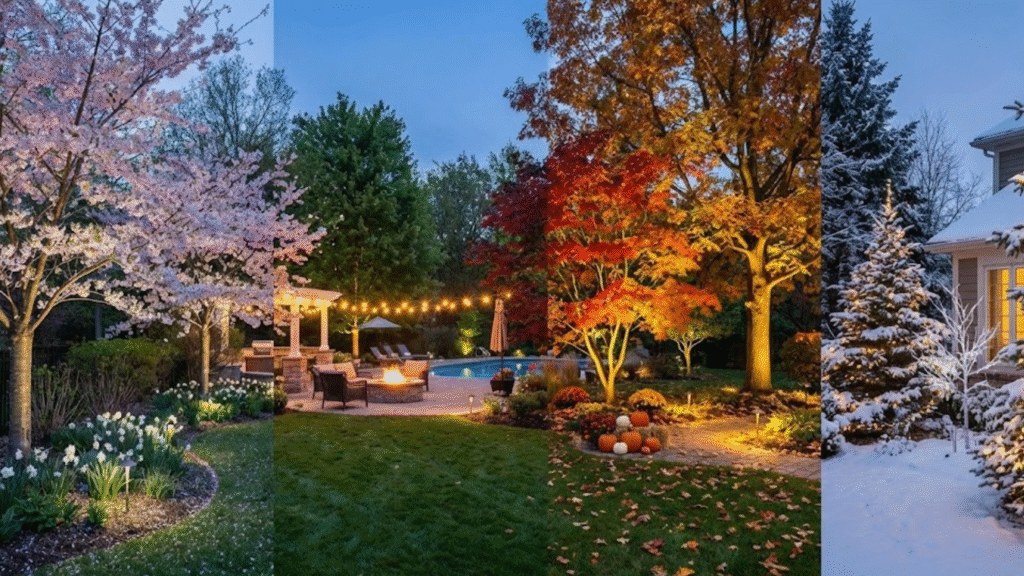
Seasonal landscape lighting is about more than brightness — it’s choosing the right fixtures, color temperatures, and control strategies so your yard works with the seasons. This guide walks through practical, season‑specific approaches that boost curb appeal, extend usable evenings, and improve safety while staying realistic for the Houston/Cypress climate. You’ll learn how uplighting, moonlighting, pathway illumination, string and deck lighting, warm fall accents, and permanent holiday setups layer together for consistent results. We include actionable techniques, recommended fixtures and Kelvin ranges, maintenance steps for weather exposure, and smart‑control tips so you can set seasonal presets. Quick‑reference tables and checklists make it easy to apply ideas whether you’re refreshing a small garden or planning a full‑property install. Practical notes emphasize weather‑resistant LEDs, entertainment zoning, and coordinating mosquito misting so summer nights are comfortable and enjoyable.
How Can Spring Landscape Lighting Enhance Your Garden’s Fresh Blooms?
Spring lighting helps new growth shine by using softer, angled illumination that brings out bloom color and leaf texture while encouraging evening use. The trick is controlling beam spread and keeping lumen output modest so petals and tender foliage keep their color and avoid washout. Landscape Lighting Experts often recommend thoughtful uplighting and gentle moonlighting to create a welcoming feel for dusk walks and early‑season entertaining. Below are targeted techniques that balance aesthetics with safety and simple upkeep so your spring display stays vibrant as plants leaf out.
Spring lighting techniques to highlight new growth and extend evening enjoyment:
- Use soft uplighting to reveal vertical structure and bloom color without harsh shadows.
- Employ moonlighting from high canopy points for dappled, natural-looking pools of light.
- Install low‑glare path lights with proper spacing to guide guests and prevent trips.
- Mix warm and neutral color temperatures to preserve petal hues and leaf tones.
These approaches favor subtlety and layering over raw output, and they set up the more specific placement tips—like beam angles and path spacing—that follow.
What Are the Best Uplighting Techniques for Spring Foliage?
Uplighting makes trunks, specimen shrubs, and small trees read naturally at night when fixtures are placed at planned distances and angles. Use roughly 30–45° beam angles for small trees and 45–60° for larger specimens to create an even wash without hot spots; this keeps flowers from blowing out and reduces glare for neighbors. Hide fixtures behind plantings or low walls, and pick warm‑to‑neutral color temps (2700K–3500K) to preserve bloom tones and add depth to textured foliage. Trim overhangs as needed and check seals after spring storms to prevent water ingress and keep performance consistent into summer.
These placement and color choices pair naturally with pathway lighting tactics that unify planting beds and circulation paths.
How Does Pathway Lighting Improve Spring Outdoor Gatherings?
Pathway lighting clarifies sightlines, adds subtle ambience, and layers with uplighting to form cohesive outdoor scenes. Use low‑voltage path fixtures spaced about 6–10 feet apart depending on lumen output, aiming for roughly 5–15 lumens per foot to stay intimate while keeping things safe. Select fixtures with shields or downward optics to avoid glare and choose finishes that complement your garden—copper and dark bronze work nicely in spring palettes. Pairing path lights with nearby accent uplights creates depth and gently draws guests toward seating, water features, or focal points.
This pathway focus naturally leads into summer planning, where zones must balance ambience, task light, and insect control.
| Fixture | Best Use This Season | Recommended Color Temp | Typical Fixture Type |
| Low‑voltage Path Light | Guiding walkways and social circulation | 2700K–3000K | Bollard or stake path light |
| Small Uplight | Highlighting specimen shrubs and early blooms | 3000K–3500K | Narrow‑beam LED spotlight |
| Moonlight Fixture | Creating dappled canopy light for ambience | 3000K–3500K | High‑mounted LED down‑shield |
What Outdoor Lighting Ideas Create the Perfect Summer Entertainment Ambiance?
Summer entertainment lighting is all about well‑defined zones—task, ambient, and accent—and layering fixtures so guests can eat, talk, and move comfortably. Zoning lets task lights support cooking and dining, ambient lights create a comfortable field of view, and accent lights highlight planters, sculptures, or water features. Choose dimmable sources and mid‑range color temps to keep skin tones flattering and lower contrast late at night. The checklist and zone example below make it simple to plan a resilient summer system that coordinates with comfort measures like mosquito control.
A concise checklist for summer entertainment lighting:
- Define lighting zones: task (dining), ambient (seating), and accent (landscape features).
- Use string or bistro lights for soft overhead ambiance in lounge areas.
- Add recessed deck fixtures and step lights at transitions for safety.
- Include dimming and scene presets to shift mood through the evening.
Layered zoning makes it easy to scale scenes for larger parties or quiet, intimate nights and leads into fixture recommendations for patios and decks.
How to Use Patio and Deck Lighting for Summer Parties?
Patio and deck lighting should blend functional task illumination for cooking and serving with warm ambient layers for social comfort, and it must be rated for summer weather. Layer overhead string or bistro lights for broad, soft ambience and add focused task lights over grills and prep areas; recessed deck and stair lights give low‑level safety illumination. Typical lumen guidance: dining task fixtures often use 200–400 lumens each, while lounge ambient fixtures work well at 50–150 lumens to keep the mood relaxed. Pick sealed fixtures rated for outdoor exposure and use presets so one control sets the right brightness for each part of the evening.
These deck strategies highlight why coordinating lighting with insect control matters—comfortable guests stay longer.
How Does Mosquito Misting Integration Enhance Summer Outdoor Comfort?
Mosquito misting integration stretches usable summer evenings by reducing biting insects in entertainment zones, so lighting scenes can remain inviting instead of driving people indoors. Best practice places misting nozzles just outside seating perimeters and downwind of prevailing breezes so a fine mist moves through occupied areas without obscuring light. Sync misting cycles with lighting scenes via timers or smart control so misting runs before guests arrive and pauses during delicate lighting effects. The result: longer, more enjoyable nights where lighting enhances the experience rather than being undermined by pests.
The table below compares common entertainment zone setups and how lighting, mosquito mitigation, and control methods work together.
| Zone | Lighting Type | Mosquito Mitigation | Control Method |
| Dining Area | Overhead bistro + table task lights | Misting nozzles outside perimeter, timed pre‑event | Dimmable scene in app or keypad |
| Lounge Area | String lights + low accent uplights | Intermittent mist cycles synced with scenes | Smart schedule with presets |
| Poolside | Underwater and perimeter accent lights | Misting at pool edge with wind‑aware placement | Integrated controller with weather override |
Natural Concepts designs and installs coordinated lighting and mosquito misting systems for Houston/Cypress homes and yards, combining professional installation with licensed staff to ensure electrical and pest‑control elements are installed safely. For homeowners who want a turnkey solution, we offer custom landscape lighting and mosquito misting integration with a free quote and consultation—Get Lit & Don’t Get Bit! This service note shows how professional coordination maximizes summer comfort without compromising design.
How Can Fall Landscape Lighting Accentuate Autumn Foliage and Warm Ambiance?
Fall lighting leans into warm tones and texture to bring out reds, oranges, and ambers and to create cozy outdoor spaces as temperatures fall. The key is selective color temperature and contrast: warmer light (lower Kelvin) deepens autumn pigments while directional accents reveal leaf edges and trunk form. Fall goals usually include intimate seating areas, highlighted specimen trees and hedges, and making permanent lighting adaptable for seasonal décor. Below are techniques and control tips so fall scenes feel inviting and permanent fixtures can safely support holiday layers.
Warm‑tone strategies to accentuate fall textures and mood:
- Favor 2700K–3000K color temperatures to enrich leaf color and wood textures.
- Use narrow‑beam uplights for silhouette and texture on trunks and major branches.
- Add lower‑intensity accents to create depth without over‑lighting fallen leaves.
- Plan programmable scenes for Halloween and Thanksgiving that layer decorations over permanent fixtures.
These warm‑tone tactics feed into practical tips for adding holiday elements safely and tastefully using your permanent lighting as the foundation.
What Warm Tone Lighting Techniques Highlight Fall Textures?
Warm‑tone lighting enhances chromatic richness in foliage and builds layered shadows that emphasize leaf edges and bark texture. Choose LEDs with strong color rendering (high CRI) and set color temps between 2700K and 3000K so reds and oranges read naturally. Position closer, narrow‑beam accents for crisp texture and balance with soft uplights for background depth. Regularly clear leaves from around fixtures and inspect seals so leaf buildup doesn’t scatter light or hide the intended effect.
Understanding these placement and color choices makes it easier to add holiday decorations without risking permanent fixtures.
How to Incorporate Holiday and Halloween Lighting into Fall Designs?
Integrating holiday lighting into fall designs means using permanent fixtures as anchors and adding temporary elements that attach safely and run on scheduled scenes. Use smart controls to create seasonal presets—one for Halloween with dynamic color scenes and one for Thanksgiving with warmer, steady tones—so decorations are activated without manual rewiring. Attach temporary items with approved methods that don’t strain seals or mounts, and connect temporary power to ground‑fault‑protected circuits when needed to minimize hazards. This keeps curb appeal high while protecting fixture longevity and design integrity.
These seasonal decoration strategies lead into winter planning for permanent holiday systems and added safety during darker months.
| Fixture | Best Use This Season | Recommended Color Temp | Typical Fixture Type |
| Accent Uplight | Emphasize trunk and texture | 2700K–3000K | Narrow‑beam spot |
| Warm Path Light | Guide walkways amid fallen leaves | 2700K–3000K | Low‑voltage path bollard |
| Festive Control Node | Seasonal color scenes and schedules | Tunable 2700K–4000K | Smart controller with RGB/tunable LEDs |
What Are Effective Winter Outdoor Lighting Solutions for Safety and Festivity?
Winter lighting prioritizes safety — clear, well‑placed path and step illumination — while also making festive displays easy with permanent holiday systems. The effective combination is contrast management and automation: strong, consistent pathway lighting reduces trip hazards when days are short, and permanent holiday systems cut annual labor while ensuring weather‑ready connections. Balance bright safety zones with low‑glare accent lighting to preserve visibility without creating light pollution. Below are practical safety measures and ideas for permanent systems that save time year after year.
Key winter lighting tips for safety and festive display:
- Prioritize pathway and step illumination with consistent spacing and 100–300 lumens where needed.
- Use motion sensors on peripheral fixtures to deter intruders and avoid steady, wasteful lighting.
- Install permanent holiday lighting systems to avoid yearly ladder work and ensure weatherproof connections.
- Highlight evergreens and architectural features with controlled uplighting to keep interest during leaf‑off months.
These steps show how winter upgrades can combine routine safety with long‑term investments that simplify seasonal decorating.
How Do Permanent Holiday Lighting Systems Enhance Winter Curb Appeal?
Permanent holiday lighting systems raise winter curb appeal by providing a durable, year‑round platform for seasonal decoration that eliminates annual installation hassle. Typical systems include weather‑rated mounting points, low‑voltage LED lines or RGB/tunable fixtures, and smart controllers for scheduled scenes. Over time, a permanent approach reduces cost and labor versus temporary installs, and automation lets homeowners schedule festive modes and return to safety lighting automatically. The convenience, consistent presentation, and safer attachments help protect facades and fixtures from damage.
These advantages naturally lead into the safety strategies that are crucial in darker months.
What Lighting Strategies Improve Safety During Darker Winter Months?
Improving winter safety means layering consistent path lighting, well‑lit steps, and strategic motion sensors to create responsive security without constant glare. Recommend 100–300 lumens for steps and 50–150 lumens for paths depending on spacing and surface reflectivity; place fixtures to avoid casting shadows across treads. Use timers and motion‑activated scenes so lights come on only when needed and avoid continuous light pollution. Pick fixtures with durable seals and appropriate IP ratings to withstand wet conditions. These measures reduce trips, define property edges, and complement festive displays so safety and style work together all winter.
If you’re considering permanent holiday lighting or seasonal safety upgrades, Natural Concepts can design and install systems tailored to Houston/Cypress properties; our licensed staff and veteran‑owned team prioritize safety, professional installation, and satisfaction. Request a free quote/consultation to evaluate permanent holiday options and safety upgrades that fit your property and schedule.
| Fixture | Best Use This Season | Recommended Color Temp | Typical Fixture Type |
| Path & Step Light | Reduce trip hazards on walkways and stairs | 3000K | Recessed step or low bollard |
| Architectural Uplight | Highlight trim, columns, and evergreens | 3000K–3500K | Wide‑beam LED accent |
| Permanent Holiday Node | Annual decorative scenes with smart scheduling | Tunable/RGB | Integrated roofline or gutter‑mounted LEDs |
Which Year‑Round Landscape Lighting Features Ensure Durability and Smart Control?
Dependable year‑round lighting starts with weatherproof materials, quality LED technology, and smart automation that supports seasonal presets and lowers maintenance. The technical foundation is durability plus intelligence: sealed fixtures protect electronics from moisture and pests, LEDs cut energy use and lamp changes, and smart controllers give zoning, scheduling, and scene control that adapt across seasons. Professional installation ensures correct transformer sizing, protected wiring, and secure mounts so failures are minimized and design intent lasts. Below are key features and a comparison table to guide fixture choices that perform across the year.
Essential features for all‑season landscape lighting:
- Weatherproof ratings (IP65 or higher) and robust seals to resist rain and humidity.
- High‑efficiency LED modules with long rated lifespans and replaceable drivers.
- Smart automation enabling zoning, dimming, scheduling, and seasonal presets.
- Corrosion‑resistant finishes, secure mounting hardware, and accessible maintenance paths.
These feature choices simplify upkeep and form the technical basis for selecting specific fixture types and control systems.
| Fixture Type | Weather Rating (IP) | Typical Lumen Output | Color Temp | Maintenance Needs |
| LED Flood | IP66 | 800–2,000 lm | 3000K–4000K | Low; occasional lens cleaning |
| Path Light | IP65 | 50–250 lm | 2700K–3000K | Low; bulb/driver check every few years |
| Uplight/Spot | IP66 | 200–1,200 lm | 3000K–3500K | Medium; alignment and seal inspection annually |
Why Choose Weatherproof LED Fixtures for All‑Season Outdoor Lighting?
Weatherproof LEDs deliver longevity, efficiency, and stable color — ideal for continuous outdoor use. LEDs’ long lifespans and low draw reduce transformer and wiring loads and cut operating costs; IP65+ weatherproofing stops moisture and insect intrusion that cause failures. When color accuracy matters, pick high‑CRI fixtures to show plants and finishes correctly, and choose replaceable seals and gaskets for easier long‑term maintenance. Investing in weatherproof LED technology reduces service calls and keeps your lighting scenes dependable year after year.
Those durability benefits pair naturally with smart automation to maximize seasonal flexibility while minimizing manual work.
How Does Smart Lighting Automation Optimize Seasonal Outdoor Ambiance?
Smart automation lets you build scene‑based presets, schedules, and remote control that shift light levels and colors as needs move from spring blooms to summer parties, fall warmth, and winter safety. Automation supports zoning so task areas can be bright while adjacent accent zones stay subtle, and it enables seasonal presets like “Spring Bloom,” “Summer Entertain,” “Fall Warmth,” and “Winter Safety” that you can trigger with a single command. Integrating mosquito misting and other outdoor systems keeps comfort coordinated without manual switching, and app or voice control gives on‑the‑fly adjustments. The result is lower maintenance and consistently appealing outdoor experiences all year.
Natural Concepts offers professional design and installation for weatherproof LED systems and smart automation in the Houston/Cypress area, with licensed electricians and pest‑control applicators on staff to ensure safe, reliable integration. For a turnkey upgrade, request a free quote/consultation and we’ll craft a durable, smart, year‑round lighting plan tailored to your landscape and entertaining needs.
| Feature | Characteristic | Benefit |
| Weatherproofing | IP‑rated enclosures and sealed connectors | Reduced corrosion and water damage |
| LED Modules | High‑efficiency, long‑life diodes | Lower energy use and fewer replacements |
| Smart Control | Zoning, scheduling, and presets | Seasonal convenience and energy savings |
- Plan with zones and scenes: Define task, ambient, and accent zones before selecting fixtures so automation can manage each area efficiently.
- Choose weatherproof LEDs: Select IP‑rated fixtures with high CRI and replaceable drivers for long‑term color stability and lower upkeep.
- Coordinate systems: Integrate lighting controls with mosquito misting and other outdoor systems to synchronize comfort measures and scenes.
Following these recommendations helps you build a resilient, year‑round lighting system that improves safety, ambiance, and curb appeal while keeping maintenance manageable.
Frequently Asked Questions
What are the benefits of using smart lighting automation for landscape lighting?
Smart automation lets you create and recall custom lighting scenes that change with the seasons. Scheduling, zoning, and remote control make it quick to adjust levels and colors for everything from spring blooms to holiday displays. Automation increases convenience, saves energy by limiting run times, and—when integrated with systems like mosquito misting—delivers a more comfortable outdoor experience.
How can I maintain my landscape lighting system throughout the year?
Keep fixtures performing with periodic inspections: clean lenses, check for corrosion or damage, and trim foliage that blocks light. Seasonally, verify seals after storms and test wiring connections and timers. Regularly test smart controls and presets so scenes run as expected. Simple seasonal upkeep prevents most issues and preserves the look you planned.
What types of fixtures are best for year-round outdoor use?
Weatherproof LED fixtures are the best choice for year‑round use thanks to durability and energy efficiency. Look for IP65 or higher to handle moisture and environmental exposure, and choose high‑CRI options when color fidelity matters. Corrosion‑resistant finishes and robust mounting hardware also lengthen service life and reduce maintenance.
How can I create a cohesive lighting design for different seasons?
Start by zoning your outdoor spaces into task, ambient, and accent areas and choose fixtures that work well together in scale and color temperature. Use smart controls to set seasonal presets so you can switch modes quickly. Dimmable fixtures and adjustable beam angles add flexibility so the same installation reads right across spring, summer, fall, and winter.
What are the best practices for integrating holiday lighting into my landscape design?
Use permanent fixtures as your base and add temporary decorations that attach safely and run on scheduled scenes. Smart controllers let you activate holiday themes without rewiring. Attach temporary elements with approved methods to avoid stressing seals or mounts, and power them from GFCI‑protected circuits when needed for safety.
How does seasonal lighting impact energy efficiency?
Seasonal lighting improves efficiency by letting you match light levels to actual needs. Smart controls and zoning limit run times and target illumination where it’s required, while efficient LEDs reduce overall power draw. The right combination of fixtures, scheduling, and scenes can significantly lower energy use while maintaining great outdoor ambiance.
Conclusion
Year‑round landscape lighting makes your outdoor spaces safer, more inviting, and more valuable month after month. By choosing weatherproof fixtures and smart controls, you can move smoothly from spring blooms to summer entertaining, fall warmth, and winter safety with minimal fuss. If you’d like help turning these ideas into a plan for your property, contact us for a free consultation — we’ll design a tailored lighting solution that fits your landscape and lifestyle. Let your outdoor spaces shine all year long.